Demokratisk tilbakegang, politisk krise og kampen for en bedre framtid: situasjonen i Georgia
Transparency International Norge har søsteravdelinger i over hundre land verden over. I mange av disse landene arbeider våre kolleger under krevende forhold, under regimer som søker å begrense ytringsfrihet og demokratiske rettigheter. Arbeidet skjer ofte i samfunn preget av omfattende korrupsjon. En av disse avdelingene er Transparency International Georgia.
TI Georgia har bistått oss med å sammenfatte teksten under. Den tar for seg opptakten til de mange demonstrasjonene som preger nyhetsbildet fra landet og beskriver dagens situasjon for sivilsamfunnsorganisasjonene der. Student Ana Takalandze har i tillegg bistått med en skildring av hvordan mange unge georgiere opplever situasjonen, og hvordan de kjemper det hun omtaler som et “symbolsk forsvar for en felles idé om en europeisk fremtid”.
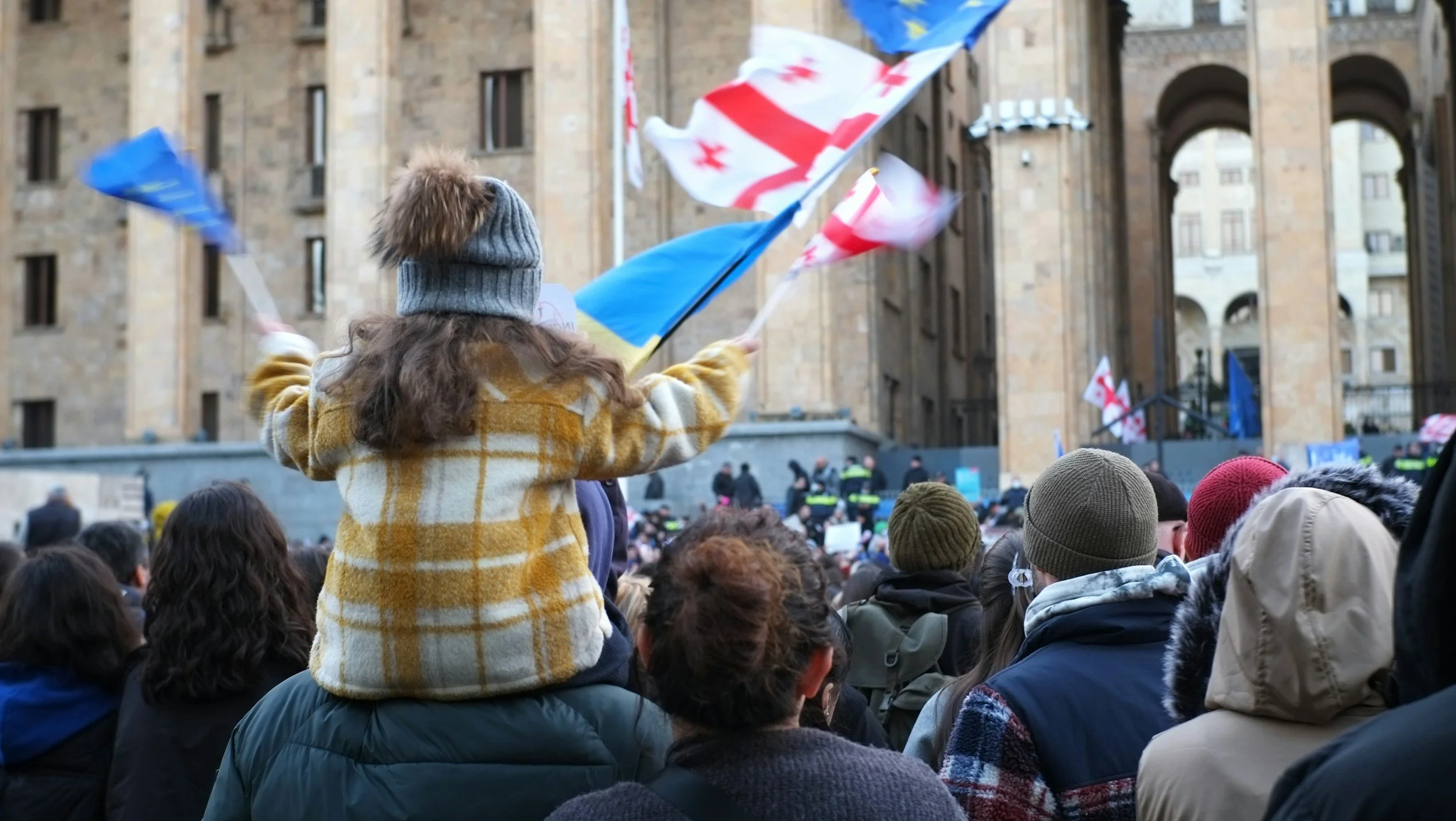
Bildet er tatt i mars 2023, i forbindelse med protester mot den foreslåtte “russiske loven” i Georgia. Foto: Sheldon Kennedy/Unsplash.
FAKTA: GEORGIA
Land i Kaukasus med 3,69 millioner innbyggere (2024). Uavhengige fra Sovjetunionen i 1991.
Georgia har falt åtte poeng på Transparency Internationals korrupsjonsindeks (CPI) fra 2018 til 2025, og har per i dag en skår på 50 av 100 poeng på indeksen. Dette er under det europeiske gjennomsnittet på 56, og enda lenger fra gjennomsnittet i EU, som er 64. Skåren plasserer landet på en 56. plass av totalt 182 land på indeksen.
Georgia har de siste tjue årene arbeidet målrettet for medlemskap i både NATO og EU. Landet leverte sin formelle søknad om EU-medlemskap i 2022, og fikk status som kandidatland i 2023. Fra 2024 har relasjonene mellom EU og Georgia blitt betydelig anspent. EU har blant annet uttrykt sterk bekymring knyttet til behandling og fengsling av opposisjonspolitikere i Georgia, samt til praksis for gjennomføring av valg.
(kilde: Snl.no)
Den politiske situasjonen i Georgia i 2026 preges av at myndighetenes tiltakende bruk av autoritære virkemidler og av ytterligere maktkonsentrasjon hos Georgian Dream, regjeringspartiet som har sittet ved makten siden 2012. Partiet ble opprinnelig ansett som EU-vennlig, men har gradvis beveget seg i en mer russiskvennlig og autoritær retning. Domstolenes uavhengighet utfordres, og ifølge TI Georgia er kontrollmekanismer i praksis satt ut av spill.[1][2] Uformelle nettverk knyttet til oligarken Bidzina Ivanishvili, grunnleggeren av regjeringspartiet og fortsatt en sentral maktfigur, har fått betydelig innflytelse over statsapparatet.[3] Korrupsjonen i landet har økt og sivilbefolkningens rettigheter er svekket.
Etter Russlands fullskala invasjon av Ukraina i 2022 har georgiske myndigheter tydeliggjort anti-vestlig retorikk, samtidig som forholdet til EU er blitt stadig mer anstrengt.[4] Til tross for bred støtte i befolkningen for europeisk integrasjon[5], har myndighetene aktivt motarbeidet den pågående tiltredelsesprosessen, og i den forbindelse vedtatt en rekke omstridte lover som igjen har begrenset handlingsrommet for sivilsamfunn, medier og politisk opposisjon. Blant annet har “den russiske loven”[6] kommet på plass, en lov som begrenser organisasjoners muligheter til å motta økonomisk støtte fra utlandet. Loven rammer TI Georgia hardt.[7]
De omstridte parlamentsvalgene i oktober 2024 og regjeringens beslutning om å stanse fremdriften i EU-forhandlingene frem til 2028 har forsterket den politiske krisen.[8][9] Disse og flere andre hendelser har vært med på å utløse omfattende protester. Georgiske myndigheter slår hardt ned på protestene, blant annet med arrestasjoner og flere tilfeller av vold.[10] Flere tusen personer er ilagt bøter i forbindelse med demonstrasjonene.[11] Hurtige lovendringer har gitt myndighetene utvidede fullmakter til å kontrollere og sanksjonere kritikere.[12] Internasjonale observatører ser med bekymring på utviklingen.[13] Utviklingen har også høstet kritikk fra blant annet norske myndigheter.[14]
Lokalvalgene høsten 2025 konsoliderte Georgian Dreams makt og kontroll over både nasjonale og lokale institusjoner. Valget ble boikottet av opposisjonen, hadde lav deltagelse og begrenset internasjonal valgobservasjon og få uavhengige, hjemlige valgobservatører. TI Georgia var for første gang på 25 år forhindret i å observere valget, blant annet grunnet sikkerhetshensyn for observatørene.[15]
Demonstrasjonene har fortsatt i 2026 og handler blant annet om at politiske fanger må frifinnes og løslates. TI Georgia rapporterer om at 57 politiske fanger ble dømt i 2025, og 66 personer ble varetektsfengslet med bakgrunn i politisk motiverte etterforskninger.[16] Flere opposisjonsledere er fengslet og risikerer lange fengselsstraffer.[17] Opposisjonspartier kan i praksis bli forbudt.[18]
Samtidig rapporterer TI Georgia om at det har blitt stadig vanskeligere å arbeide i Georgia for uavhengige medier og journalister. De siste årene er det dokumentert hundrevis av voldsepisoder og trusler mot journalister, samt andre hindringer av journalistisk arbeid. I perioden januar-april 2026 registrerte TI Georgia om lag 60 slike tilfeller.[19]
Sivilsamfunnsorganisasjoner utsettes for falske anklager, trakassering, etterforskning og sanksjoner, som frysing av bankkontoer. Dette gjelder også TI Georgia, hvor direktør Eka Gigauri blant annet er innkalt til avhør basert på det organisasjonen beskriver som politisk motiverte og grunnløse anklager. Avhørene omtales som et virkemiddel for å svekke antikorrupsjonsorganisasjonens virksomhet.
Lederen i det internasjonale styret for Transparency International, François Valérian, uttalte i september 2025 at forfølgelsen av TI Georgia utgjør et direkte angrep på demokratiet. Dersom Gigauri blir dømt for anklagene, risikerer hun opptil 15 års fengsel.[20]
I 2026 fremstår Georgia som et land der sivilsamfunnsorganisasjonene fortsatt er tilstede, men med klart svekket handlingsrom. Risikoen er stor for ytterligere demokratisk tilbakegang dersom dagens kurs fortsetter.
Samtidig er støtten til demokrati og europeisk integrasjon fortsatt sterk i befolkningen. Til tross for økende press fortsetter sivilsamfunnsorganisasjoner, uavhengige medier og brede samfunnsgrupper å mobilisere for demokratiske reformer, rettsstatlige prinsipper og en framtid for Georgia.
What’s Going on in Georgia?
Teksten under er skrevet av Ana Takalandze, jurist og tidligere ansatt i Transparency International Georgia. Det siste året har hun hatt et opphold som utvekslingsstudent ved Universitetet i Agder (UiA) i forbindelse med sin mastergrad i PR. Mens hun arbeidet i TI Georgia gjennomgikk landet store politiske endringer som gjorde situasjonen for sivilsamfunnsorganisasjoner svært vanskelig: Blant annet ble den såkalte «utenlandske agenter»-loven, også kjent som den russiske loven, vedtatt. Debatten om Georgias demokratiske og europeiske fremtid preget arbeidet til sivilsamfunnsorganisasjoner og formet den bredere offentlige diskursen.
I teksten under forteller Ana om den nåværende politiske situasjonen, utfordringene for sivilsamfunnet og hvordan unge mennesker kjemper mot autoritære krefter i Georgia, og for ideen om en europeisk fremtid.

Ana Takalandze (foto: privat)
Democratic Backsliding, Political Crisis, and the Struggle for the Country’s European Future
Text by: Ana Takalandze
For more than a decade, Georgia was widely regarded as one of the most promising democratic reformers in the post-Soviet space. Strong public support for European integration, relatively pluralistic political competition, and ongoing institutional reforms positioned the country as a regional success story. However, by 2026, this trajectory has come under serious strain. The country is now experiencing a profound political and societal crisis, marked by disputed electoral processes, mass civic mobilization, institutional polarization, and increasing tension with Western partners.
At the core of the current developments lies a fundamental contest over the direction of the Georgian state. The ongoing crisis is not merely a cyclical political confrontation between government and opposition, but rather reflects a deeper structural conflict concerning democratic governance, state legitimacy, and geopolitical orientation.
The escalation of tensions can be traced back to the parliamentary elections of October 2024, which became a turning point in the country’s recent political history. Although elections in Georgia have historically been competitive, the 2024 vote was accompanied by widespread allegations of administrative resource misuse, voter intimidation, and an uneven playing field. Domestic watchdog organizations and segments of the international community questioned the integrity of the process, contributing to a decline in public trust toward electoral institutions. The perception that formal democratic procedures were no longer capable of ensuring fair political competition became a key driver of subsequent mobilization.
European Integration: From National Identity to Mass Mobilization
This fragile legitimacy was further undermined by the government’s decision to suspend progress on European Union integration until 2028. In the Georgian context, European integration has long functioned not only as a foreign policy objective but as a central pillar of national identity and state-building. Consequently, the suspension was widely interpreted not as a temporary policy adjustment but as a strategic deviation from a historically entrenched national consensus. The decision triggered sustained mass protests, initially concentrated in Tbilisi but later expanding to other urban centers, and involving a broad cross-section of society.
What distinguishes the current protest movement is both its durability and its sociological composition. Unlike earlier waves of political protest, which were often driven by party structures or short-term grievances, the 2024–2026 mobilization reflects a more diffuse and value-oriented civic engagement. Participants include students, journalists, public sector employees, cultural figures, and non-affiliated citizens. Their demands extend beyond immediate political outcomes and instead articulate broader concerns related to democratic accountability, civil liberties, and the preservation of a European trajectory.
The centrality of Europe in this crisis cannot be overstated. For a significant portion of the Georgian population, the concept of “Europe” embodies a normative framework associated with rule of law, institutional independence, human rights protections, and socio-economic modernization. The granting of EU candidate status in 2023 reinforced expectations that Georgia was irreversibly moving toward integration with European structures. In this context, any perceived reversal generates not only political dissatisfaction but also a sense of existential uncertainty regarding the country’s future orientation. Thus, the protest movement can be understood as both a political and symbolic defense of a collectively imagined European future.
Democratic Backsliding and the Shrinking Civic Space
Parallel to these developments, critics of the government point to patterns consistent with democratic backsliding. These include the increasing concentration of power within the ruling elite, the weakening of institutional checks and balances, and the politicization of key state bodies such as the judiciary and regulatory agencies. Concerns have also been raised regarding the shrinking space for civil society organizations and independent media. Legislative initiatives targeting non-governmental organizations—particularly those receiving international funding—have been interpreted by critics as attempts to delegitimize and constrain civic actors. Similarly, the media environment has become increasingly polarized, with allegations that pro-government outlets function as instruments of political messaging, while independent journalists operate under growing pressure.
The handling of protest activity has further intensified scrutiny. Reports of disproportionate use of force, mass detentions, and financial penalties against demonstrators have raised questions about the government’s commitment to fundamental freedoms, including the right to assembly and expression. While authorities justify these measures in terms of maintaining public order and state stability, critics argue that such practices contribute to the erosion of democratic norms and deepen societal divisions.
The Youth Movement and Educational Reforms under Scrutiny
An important dimension of the current crisis is the prominent role of younger generations. Students and young professionals have emerged as key actors within the protest movement, bringing both organizational capacity and symbolic significance. For many of them, the perceived derailment of the European integration process directly affects their expectations regarding education, employment, and mobility. University spaces have increasingly become arenas for political debate and mobilization, and recent legislative changes affecting higher education governance have further catalyzed student engagement. The involvement of youth suggests that the crisis is not limited to elite-level political competition but reflects broader generational concerns about the country’s long-term trajectory.
In April 2026, student protests in Tbilisi continued to reflect the broader political tensions that began in late 2024.
Critics argue that these reforms are part of a wider shift by the ruling Georgian Dream party away from Western integration, a trend they say has intensified since Russia’s invasion of Ukraine in 2022. Once seen as a country moving steadily toward the European Union, Georgia is now, according to opponents, drifting closer to Moscow.
The government, however, maintains that the reforms aim to improve efficiency in the education system. The policy introduces a “one faculty, one city” model, under which only one university in each city will offer specific academic programs. Officials argue that this will better align education with labor market needs and reduce the concentration of universities in Tbilisi.
Opponents see the changes differently. They warn that the reforms will weaken leading institutions, particularly Ilia State University, one of the country’s most internationally connected and academically prominent universities. According to university representatives, the majority of its programs will be cut, drastically reducing student admissions and potentially forcing the institution to close within a few years.
Concerns have also been raised that the reforms may have political motivations. Some analysts suggest that redistributing faculties across regions could disperse large groups of student protesters. A recent report by the OSCE noted broader signs of democratic backsliding in Georgia and highlighted concerns surrounding the education reforms.
Geopolitical Repercussions: Sanctions and the Disinformation Front
International reactions to developments in Georgia have become progressively more critical. By 2026, Western actors, including the United States, the United Kingdom, and several European states, have imposed targeted sanctions on a significant number of Georgian officials, judicial figures, and media representatives. These measures are linked to allegations of human rights violations, democratic regression, and involvement in disinformation activities. In parallel, the European Union has adopted a more cautious approach toward Georgia’s integration process, including the suspension of certain privileges and ongoing discussions about further conditionality.
A particularly notable development occurred on February 24, 2026, when the United Kingdom imposed sanctions on two major Georgian media outlets, Imedi TV and POSTV. According to official statements, these organizations were involved in disseminating pro-Kremlin narratives and contributing to broader disinformation campaigns in the context of Russia’s war against Ukraine. This step is significant in that it extends the scope of accountability beyond traditional political actors to include media institutions, framing information dissemination as a component of geopolitical competition. The decision has generated polarized responses domestically, with government supporters framing it as external interference, while critics interpret it as a necessary response to systemic disinformation.
The implications of these sanctions have extended into the economic sphere, particularly affecting the relationship between media and the private sector. As advertising constitutes a primary revenue source for broadcasters, attention has shifted to companies that continue to finance sanctioned outlets. Civil society organizations have highlighted potential legal, reputational, and compliance risks associated with such practices. Consequently, businesses operating in Georgia are increasingly confronted with complex ethical and strategic considerations, including the alignment of their marketing decisions with broader principles of corporate responsibility and international regulatory frameworks.
In this sense, the Georgian crisis has transcended the boundaries of conventional politics. It now encompasses interconnected domains of governance, civil society, media systems, and economic behavior. The interplay between domestic developments and international responses underscores the extent to which Georgia’s trajectory is embedded within wider geopolitical dynamics.
Georgia in 2026 stands at a critical juncture. The ongoing crisis reflects not only immediate political disputes but also deeper structural tensions related to democratic resilience, institutional integrity, and national identity. Whether the country will maintain its European orientation or shift toward a more illiberal model remains uncertain. What is clear, however, is that the outcome of this process will have long-term implications for Georgia’s political system, its societal cohesion, and its position within the international order.
Kilder:[1] Transparency International Georgia, “Is Georgia a Captured State?"[https://www.transparency.ge/en/blog/georgia-captured-state][2] Civil.ge, "Archives: Georgia’s Chaotic Memory"[https://civil.ge/archives/669098][3] Transparency International Georgia, “Oligarch Bidzina Ivanishvili - the real ruler of Georgia and the architect of Georgia’s pro-Russian shift”[https://transparency.ge/en/post/oligarch-bidzina-ivanishvili-real-ruler-georgia-and-architect-georgias-pro-russian-shift][4] Speech by the EU Ambassador Pawel Herczynski at the Press Conference, following the publication of the 2025 EU Enlargement Report on Georgia
https://www.eeas.europa.eu/delegations/georgia/speech-eu-ambassador-pawel-herczynski-press-conference-following-publication-2025-eu-enlargement_en?s=221[5] EUs Neighbours East, Annual Survey 2025: Georgia https://euneighbourseast.eu/news/publications/annual-survey-2025-georgia/[6] BBC News, "Georgia approves controversial 'foreign agent' law, sparking more protests"[https://www.bbc.com/news/world-europe-69007465][7] Morgenbladet, “Rammes snart av Georgias ‘utenlandsk agent’-lov”[https://www.morgenbladet.no/aktuelt/rammes-snart-av-georgias-utenlandsk-agent-lov/9197906][8] European Parliamentary Research Service (EPRS), briefing 762474 (2024)[https://www.europarl.europa.eu/RegData/etudes/BRIE/2024/762474/EPRS_BRI(2024)762474_EN.pdf][9] Politico Europe, “Georgia hits brakes on EU accession bid”[https://www.politico.eu/article/georgia-pause-eu-accession-bid-until-2028-irakli-kobakhidze/][10] Transparency International Georgia, “Everyone who committed crimes against participants in peaceful protests must be brought to justice”[https://transparency.ge/en/post/everyone-who-committed-crimes-against-participants-peaceful-protests-must-be-brought-justice/}[11] Transparency International Georgia, “41 steps towards Russia…”[https://transparency.ge/en/blog/41-steps-towards-russia-one-year-georgian-dreams-anti-european-course/][12] Transparency International Georgia, “Road to dictatorship…”[https://transparency.ge/en/blog/road-dictatorship-georgian-dreams-latest-repressive-legislative-changes][13] Amnesty International, “Georgia: Authorities built coordinated system to crush dissent and entrench power”[https://www.amnesty.org/en/latest/news/2026/06/georgia-authorities-built-coordinated-system-to-crush-dissent-and-entrench-power/][14] Regjeringen.no, “Norway responds to negative developments in Georgia”[https://www.regjeringen.no/en/whats-new/norway-responds-to-negative-developments-in-georgia/id3086106/][15] Transparency International Georgia, “Transparency International Georgia will not observe October 4 2025 local elections”[https://transparency.ge/en/post/transparency-international-georgia-will-not-observe-october-4-2025-local-elections][16] LinkedIn-post (Gigauri, Eka)[https://www.linkedin.com/posts/gigaurieka_servingthepeople-activity-7414334818210955264-_ogk/][17] BBC News, "Georgia jails six political figures in one week in crackdown on opposition"[https://www.bbc.com/news/articles/ckg5x53z7djo][18] Transparency International Georgia, “Ban on political parties and their members will ultimately undermine democracy in Georgia”[https://transparency.ge/en/blog/ban-political-parties-and-their-members-will-ultimately-undermine-democracy-georgia][19] Transparency International Georgia, “Independent media target…”[https://transparency.ge/en/blog/independent-media-target-ivanishvili-regime][20] Transparency International, "Transparency International faces escalating attacks in Georgia"[https://www.transparency.org/en/press/transparency-international-faces-escalating-attacks-in-georgia]